UN-MADE WITH LOVE
*
UN-MADE WITH LOVE *

An ongoing reflection on nourishment, memory, value, and the art of becoming
↑ Press plaaaaaaay…
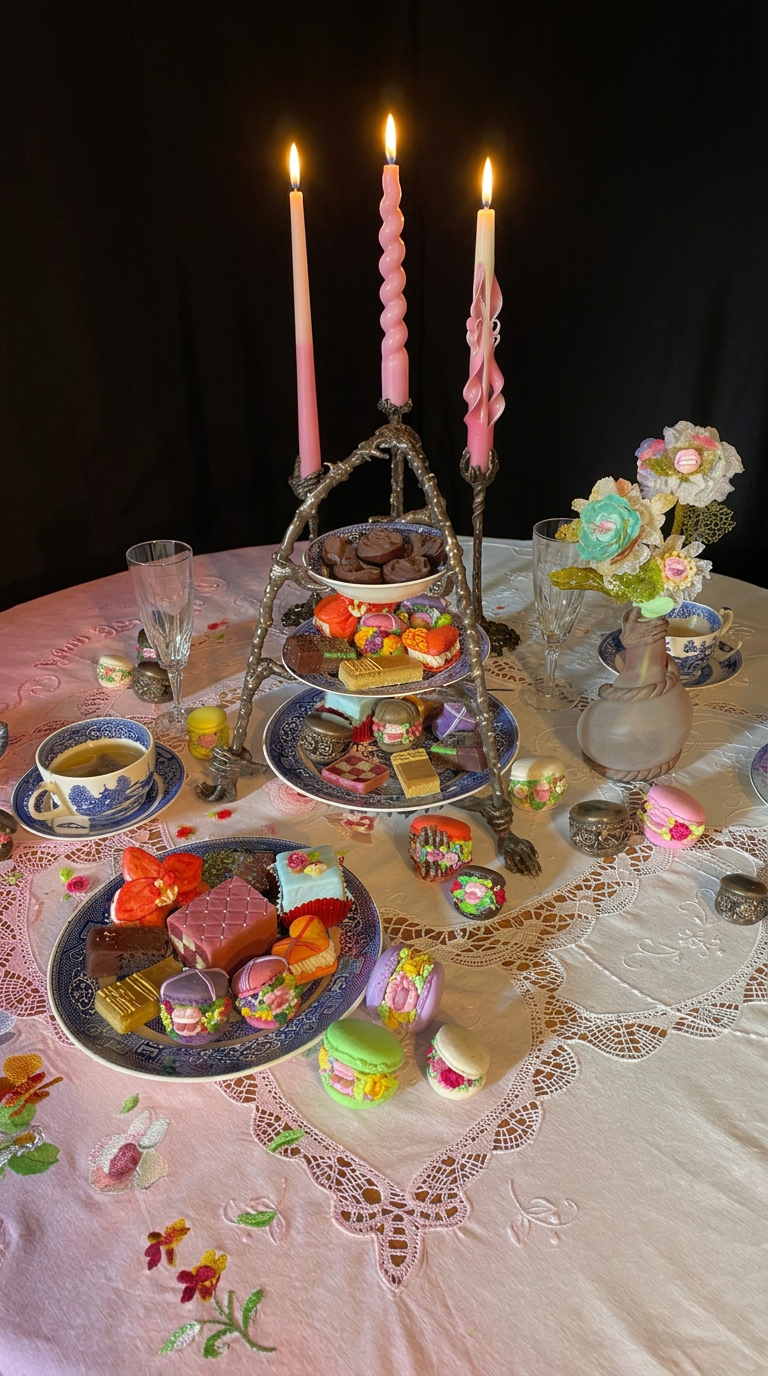
'𝓤𝓷-𝓜𝓪𝓭𝓮 𝓦𝓲𝓽𝓱 𝓛𝓸𝓿𝓮' - 2024, Bronze, glass, embroidery, edible and non edible art. Music: 'Sweet Dreams' - Eurythmics.
Spring Break New York ‘24 Shortlisted final round.

↑ play meeee....
Music credit - 'Biting Down' - Lorde
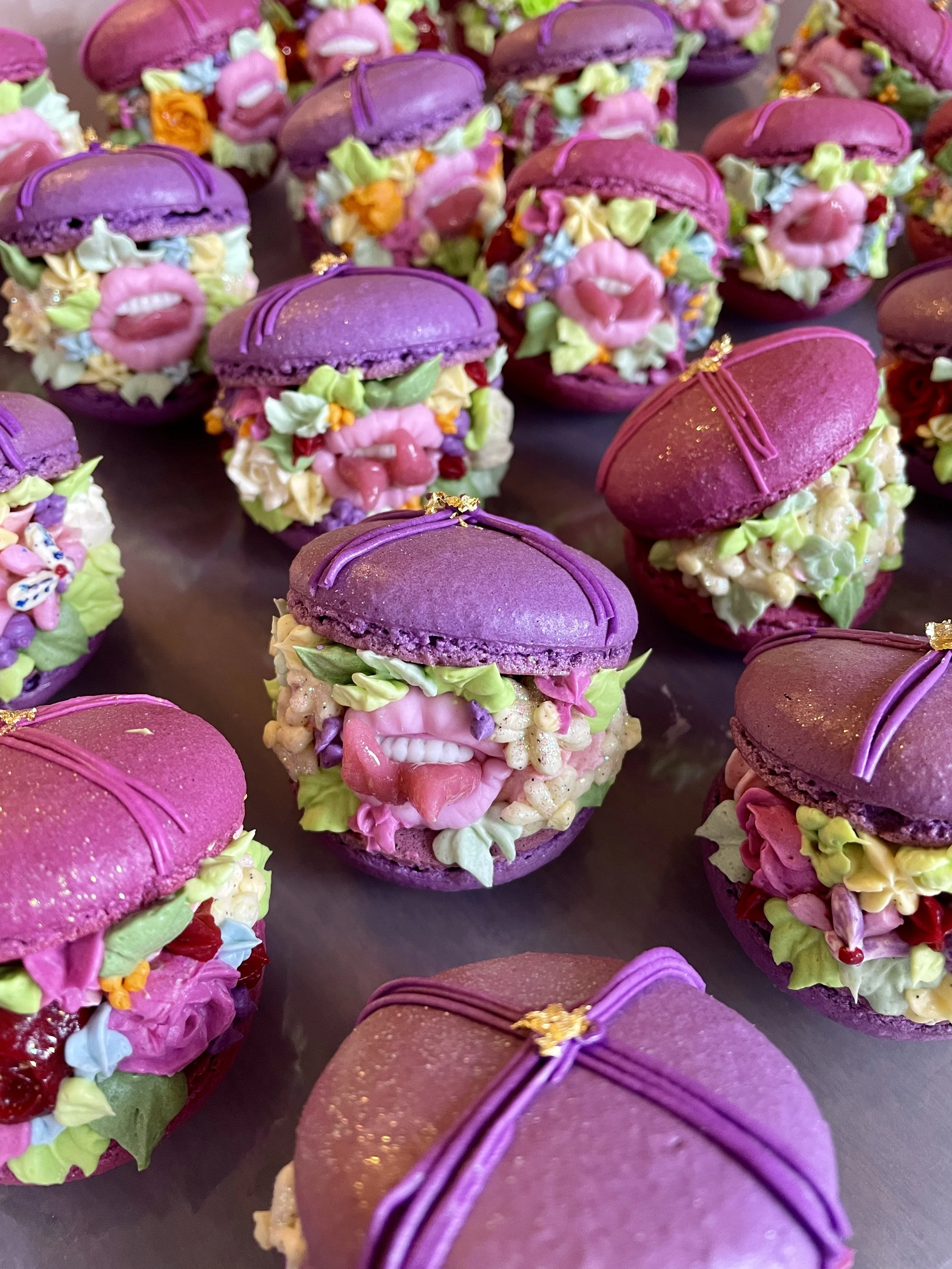
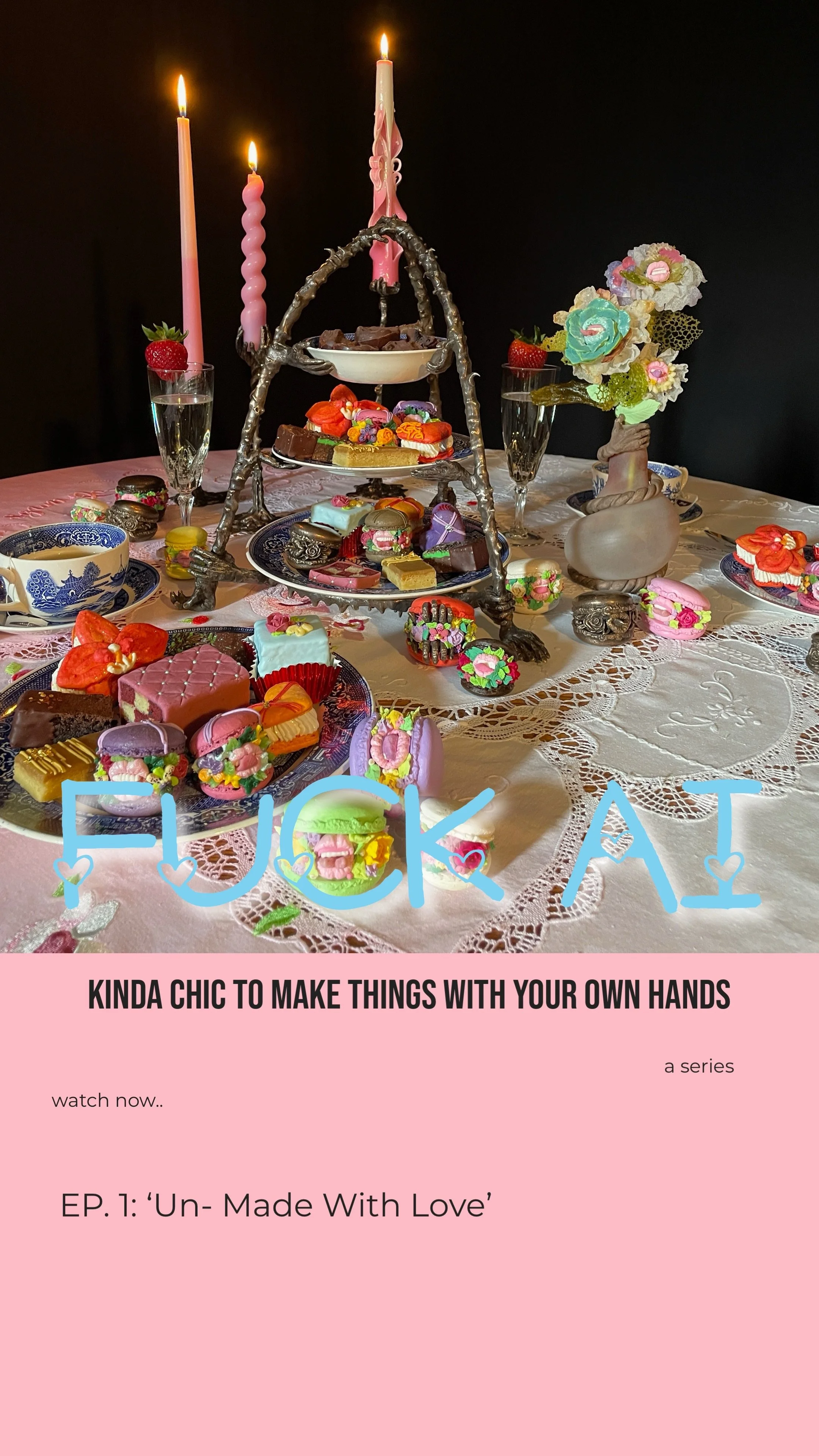
Edible & inedible cakes, erotic bonbons, ‘Taunting’ bouquet macarons, slices, petit fours and chocolates.
An invitation to my table
With ‘𝓤𝓷-𝓜𝓪𝓭𝓮 𝓦𝓲𝓽𝓱 𝓛𝓸𝓿𝓮’, I invite people into an immersive, multimedia performance installation that takes the form of a formal dining room: a lush, intimate, occasionally unsettling tea party in which bronze, glass, embroidery, edible art, and non-edible objects exist alongside one another. I bring my internal experiences of pleasure, pain, expectation, shame, and love into an external space where they can be encountered through the body—not simply looked at, but felt, discussed, touched where appropriate, and, in some instances, eaten.
I am interested in our relationship with sugar as something coded with bodily memory. Sweetness is rarely just a flavour. For me, it carries associations with celebration, comfort, reward, longing, restraint, family, femininity, indulgence, and guilt. A mouthful can take me somewhere I have not visited in years. A particular texture can return me to a kitchen, a relationship, an expectation, or a version of myself I thought I had left behind.

Through this work, I explore the transformative power of making and sharing food while processing generational and gender-based trauma. I ask how nourishment can extend beyond the body into the mind and soul, and how the act of preparing something for another person can become both a deeply intimate offering and a complicated expression of what I believe I must give in order to be loved.
My table is filled with carefully constructed high-tea objects: candles, cake stands, plates, floral arrangements, handmade sweets, and sculptural forms. Each object is unique rather than editioned, and each holds a connection to a core relationship. Lovers, mothers, family, friends, and the emotional lives we build around one another appear through cakes, buttercream flavours, floral motifs, materials, and gestures.
I do not necessarily explain every reference immediately. I am interested in what happens when someone encounters the work first through attraction, curiosity, or appetite, and only gradually discovers the emotional architecture beneath its surface.
Some objects are static and inedible. Others are fragile, perishable, and intended to be consumed. Their differences can be almost imperceptible to the eye. A macaron may offer the expectation of sweetness and then refuse it through the permanence of bronze or glass. An apparently ornamental flower may, instead, be entirely edible.
I use that uncertainty deliberately. I want to interrupt the easy assumption that looking tells us everything we need to know about something—or someone.
During timed high-tea sessions, I sit with participants as edible components are eaten, replenished, and replaced. We share personal histories of food and family. The conversation is not supplementary interpretation placed beside the artwork; it is part of the artwork itself. What someone remembers, what they hesitate to say, what makes us laugh, and what becomes unexpectedly tender all contribute to its unfolding.
I do not see the table as complete before people arrive. Their presence changes it. The work happens through that change.

▶ ‘The Crumbs’ Hand dyed, hand and machine embroidered English/ Irish linen & cotton table cloth.
The crumbs I choose to keep
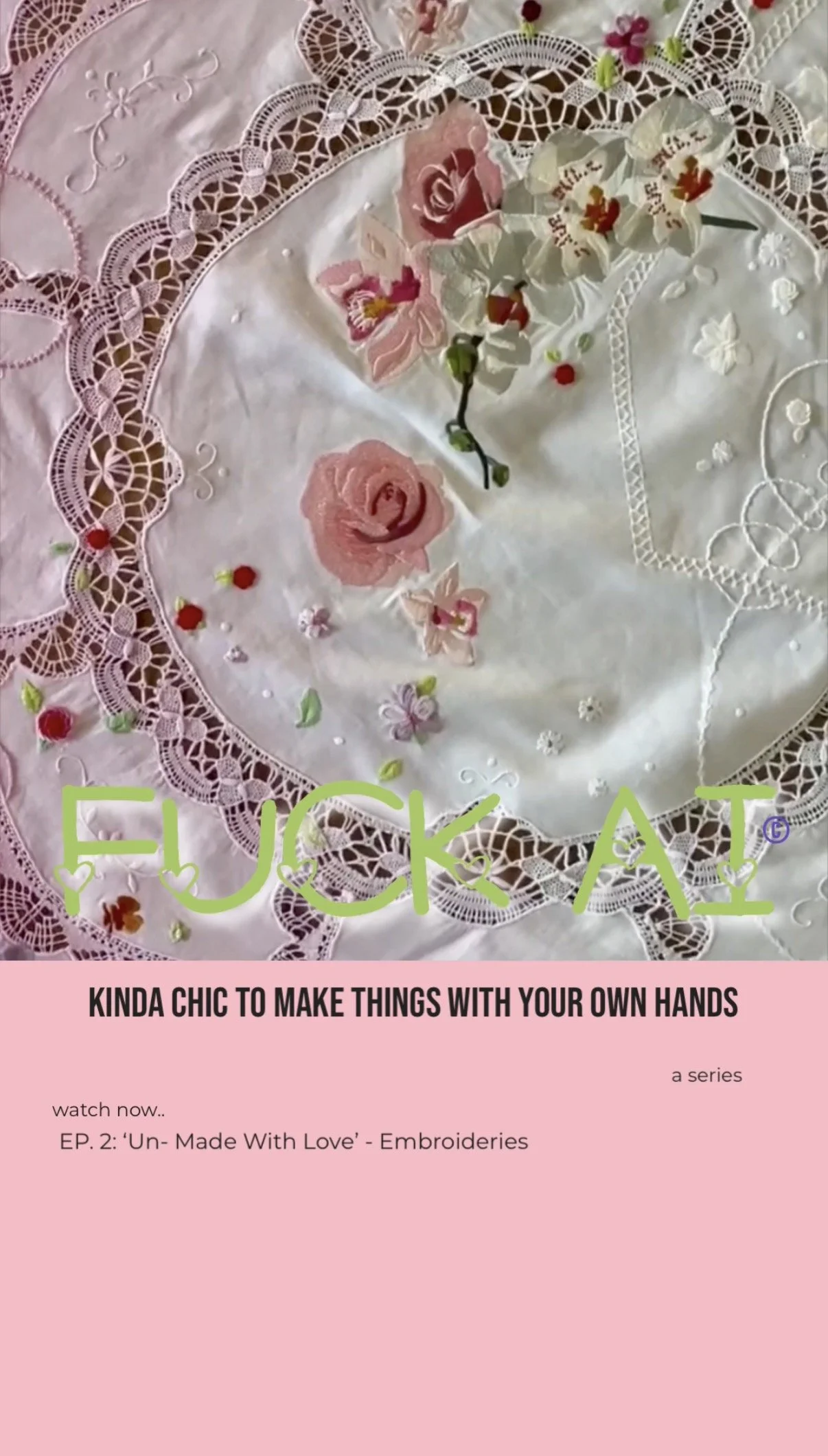
Beneath these objects sits ‘The Crumbs’: my hand-dyed antique Irish linen-and-cotton tablecloth, worked with hand and machine embroidery. I think of it as an ongoing portrait of love and labour in the domestic space.
As we eat together, marks, stains, and crumbs interrupt its surface. Instead of treating these traces as damage to be removed, I embroider around and over them. I return to what has been left behind and give it further time, attention, and care. The cloth becomes a record of encounters rather than a surface restored to innocence after every meal.
I am interested in that reversal. So much domestic labour is devoted to making evidence disappear: washing the plates, clearing the table, removing the stain, restoring order, preparing for the next occasion. The more successfully that labour is performed, the less visible it can become.
With ‘The Crumbs’, I choose not to erase the evidence.
I preserve the interruption. I give the spill a place. I allow the untidy remainder of being together to become something worth looking at.
The embroidery does not recreate the conversation or return us to the meal. It cannot. What it offers is an acknowledgement that something happened here, that people occupied this space, and that their presence mattered enough for me to sit with its traces afterwards.
The work continues after the guests leave. My hands return to the cloth, carrying out another kind of hosting: attending to the memory of the encounter.
I see that as a portrait of relationships, too. What remains after an interaction is not always the thing that was deliberately offered. Sometimes it is an accidental sentence, an awkward silence, a kindness that appeared insignificant at the time, or a mark we did not realise we had made. These seemingly insignificant happenings can actual be catalysts to life changing decisions.
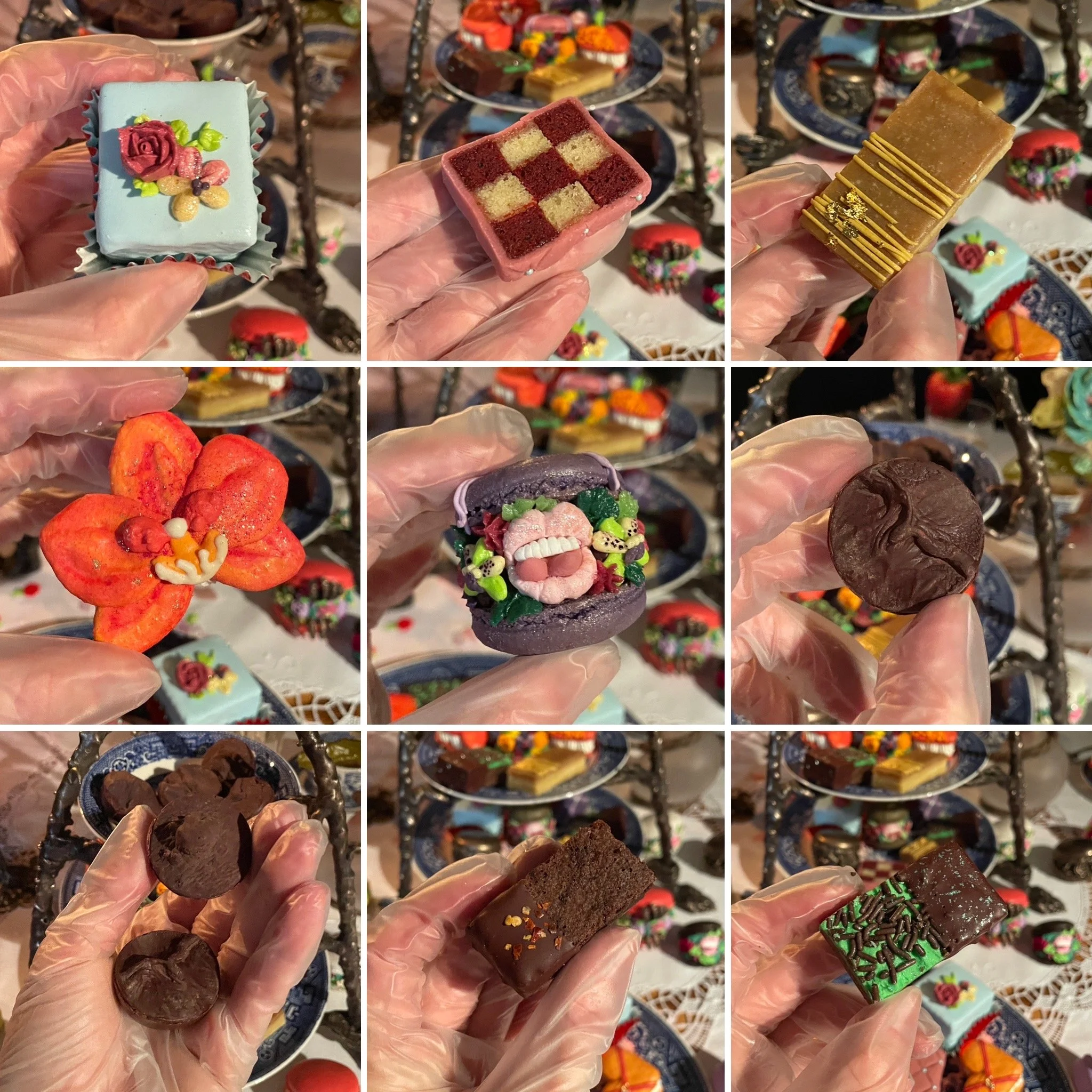
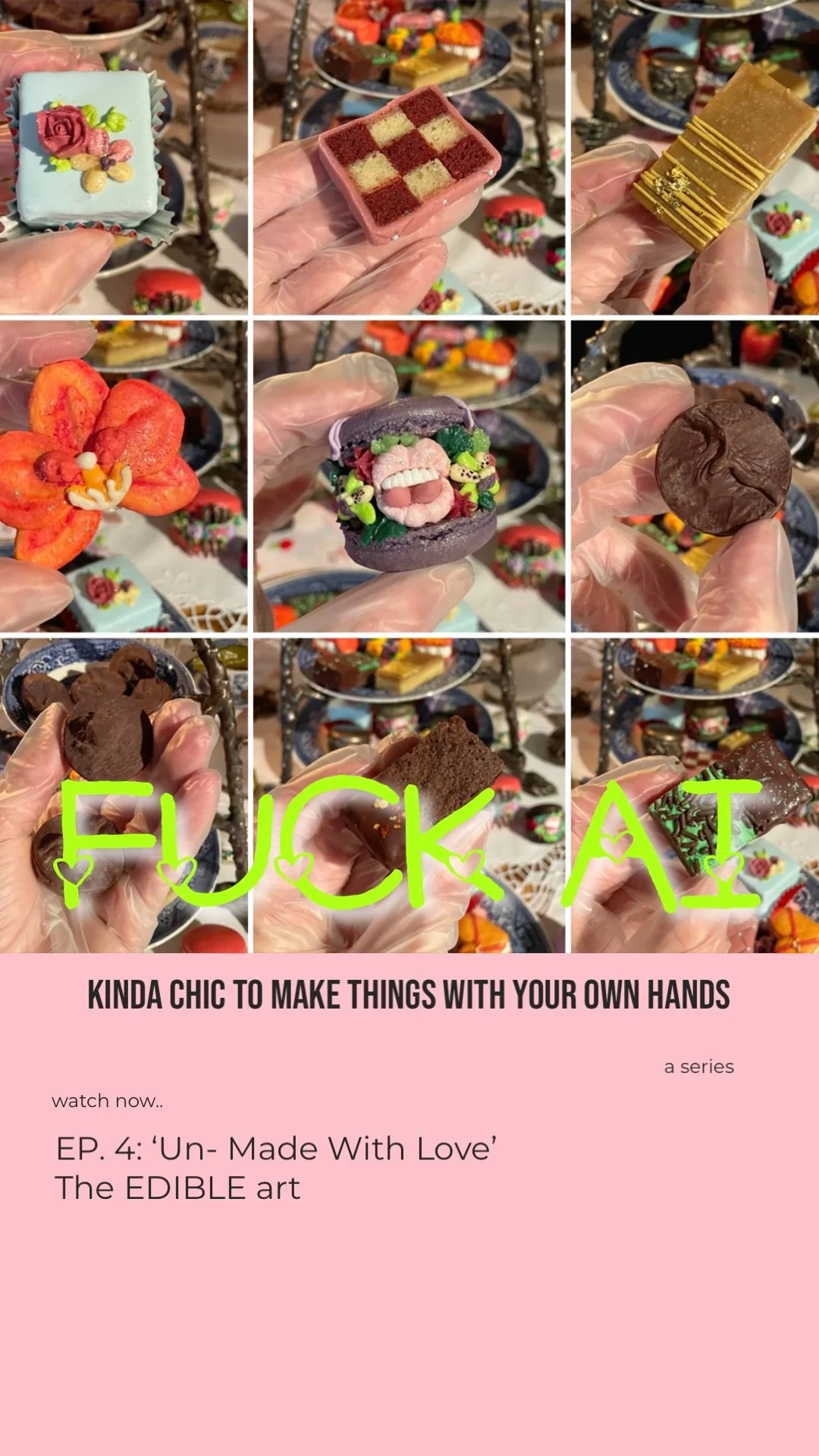
From top left clockwise. the edible selection - Petit fours, Battenberg, ginger crunch, erotic chocolate bonbon, peppermint slice, chili triple chocolate brownie, orchid macarons, center: ‘Taunting’ bouquet lip macaron
Sugar: my nemesis, my material
My relationship with food is not an abstract conceptual starting point. It comes from nearly two decades of living with an eating dis’order’, body dysmorphia, and the exhausting negotiation between what I appeared capable of doing and what I could barely manage privately. (’order’ is intentionally separated because it was very important turning point in my recovery where I mentalised my eating complications less as an illness and imposition and more as a strategy I initially used to help myself in very difficult times).
For years, I begged simply to be able to eat three meals a day without the compulsions, fear, and mental calculations that surrounded them. I thought ordinary eating was something other people understood instinctively and that I might never be able to access.
Easter, Christmas, birthdays, and meals with friends were elaborate psychological obstacles. What looked like a happy occasion from the outside feel, internally, like a situation requiring hours of anticipation, avoidance, bargaining, and shame.
I became skilled at appearing functional while feeling trapped. I could create, work, achieve, and offer things to others, yet struggle profoundly to offer myself the most basic forms of care.
I once believed I would never be able to go through a day, enjoy treats, and not think about purging or restricting.
Today, I can.
That change remains extraordinary to me. It gives the work its emotional stakes. Sugar, which once occupied such a painful place in my life, has become a medium through which I celebrate pleasure and initiate conversations about relationships, identity, gratification, shame, remorse, expectations, and value.
I have not erased its history. I have changed the relationship.
I do not need to pretend that something never hurt me in order to encounter it differently now.
In ‘𝓤𝓷-𝓜𝓪𝓭𝓮 𝓦𝓲𝓽𝓱 𝓛𝓸𝓿𝓮’, I work with the very material around which so much fear once gathered. I shape it, study it, share it, and allow it to disappear without demanding that its disappearance become another act of punishment.
That is part of the unmaking: not the destruction of myself, but the gradual loosening of the systems through which I learned to turn against myself.
Learning to love the self I thought I had to remove
One of the most difficult lessons in my recovery was recognising that I had to love the version of myself who was unwell.
Not tolerate her until I could replace her. Not make her earn tenderness through improvement. Not withhold acceptance until she had become easier, more productive, more disciplined, or more convenient.
I had to recognise that she was already worthy of care.
For a long time, I imagined wellness as an act of subtraction. I thought I needed to eradicate the ugly parts, tighten what jiggled, remove the difficult feelings, suppress what frightened me, and present a version of myself that no longer caused concern.
What began to change things was the possibility that my horrible and my beautiful could exist together without cancelling each other out.
I did not have to deny the seriousness of my compulsions to stop treating myself as morally defective. I could acknowledge that my behaviours were harming me while also trying to understand the distress they had been attempting (however painfully) to manage.
My recovery took a spiritual and experiential direction. I invested in activities that helped me rebuild intuition, develop self-confidence, speak more kindly to my inner child, and experience my body as capable rather than as an object to monitor and correct.
Some medical interventions I experienced did not feel helpful to me, and I experienced parts of that period as making me feel worse. I want to keep that account personal rather than turn it into a universal judgement about treatment. I cannot prescribe another person’s route to recovery, and I do not see my experience as a reason for anyone else to abandon care that supports them.
What I can say is that the Overeaters Anonymous rooms became a place of safety for me. I returned to a community where I could speak honestly and begin to meet the parts of myself I had been trying to reject.
Alongside that support, creativity, spiritual reflection, movement, travel, and human connection helped me rebuild trust in myself. I began to find a different relationship with my body through what it could do, not simply through how it looked.
I did not recover by becoming flawless. I began to recover by becoming less hostile to my own humanity.
That distinction runs through this entire performance + installation.

↑ V>I>D>E>O 'Un-Made With Love' - 2024
Music credit - 'Uninvited' - Alanis Morrisette

▶ Music credit: Banks - Propaganda
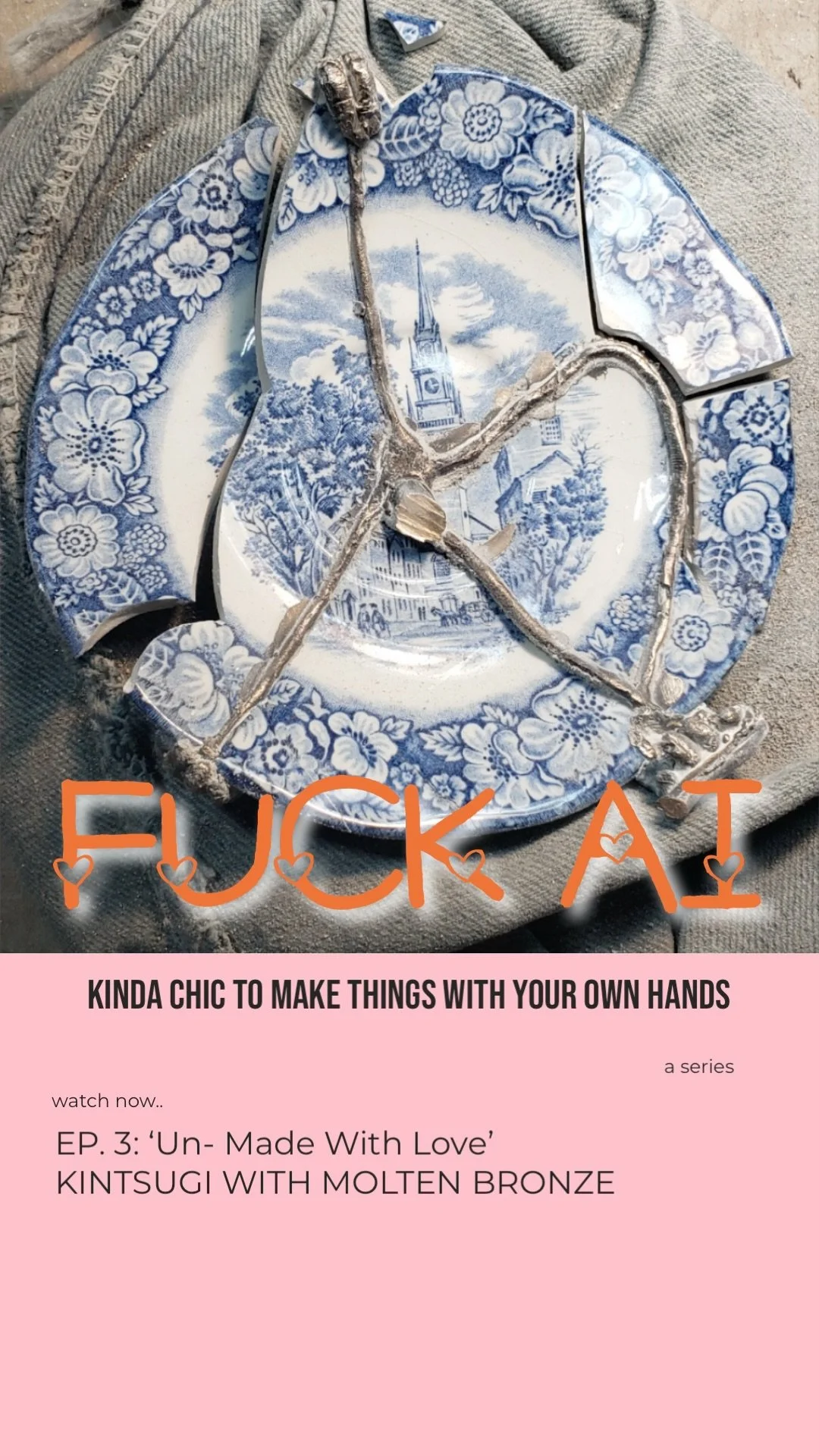
→ ‘Perfectly Flawed’ sitting atop ‘The Crumbs’ embroidered tablecloth. Molten bronze as kinstugi with broken Homer & Laughlin plates, a technique which is a completely unique application of the kintsugi process (using molten bronze).
The hug I could not buy
One memory continues to clarify the relationship between food, longing, and emotional reassurance for me. This was a realization that had powerful positive ramifications towards recovery and understanding:
After two months trying to find work in London, I found myself exhausted and lonely at Schiphol Airport, sitting opposite a convenience store and fighting an urge to buy comfort food. Instead of immediately acting, I stayed where I was and tried to notice what was happening.
Vivid images of comfort foods my Nana and Mum had made came into my mind, along with shame, uncertainty, a berating internal monologue for all the things I hadn’t done in London (completely missing all the things I had) and a desperate longing for a hug.
The hug was the important part.
I began to recognise that, in that moment, I was seeking emotional reassurance in something that could not provide the particular comfort I needed. My hunger for safety and affection had become tangled with the possibility of buying and consuming something.
I do not interpret that memory as an argument against taking pleasure in food. Quite the opposite. I wanted to recover the possibility of food being food—delicious, sustaining, pleasurable, social—without asking it to repair every wound or stand in for every form of love.
That distinction matters to my tea party. I am not offering a confection as a cure. I am offering food within an encounter: alongside conversation, attention, company, and the possibility of being seen.
I know how different a mouthful can feel when it is accompanied by kindness rather than scrutiny.
I also remember a later relationship in which beautiful restaurants and small plates of delicious things became places of unexpected ease. We talked and nibbled for hours without pressure, sometimes until the chairs were being put up around us. He did not know the full weight of what I was carrying, yet he helped put pleasure into a place I had painted with pain.
I carry that understanding into this work. Sometimes care changes an experience before anyone has found the words to explain why.
Making, providing, and being consumed
As a self-taught, accredited pâtissier and pastry chef, I spent years reflecting on what people expected from me as a maker and provider. Those expectations did not remain in the professional kitchen. They overlapped with what was expected of me as a daughter, a lover, a friend and, more recently, a mother of two.
The same small actions could contain very different emotional realities. Measuring, mixing, folding, piping, polishing, arranging, repeating: these could feel absorbing and joyful, or constraining and relentless.
I became interested in the pendulum swing between the pleasure of creation and the demands of production.
When does making something beautiful become an obligation to keep making it? When does generosity become an expectation? When does a skill I love become a reason that my time is treated as endlessly available?
My move away from food production as a profession and towards food as an art practice gave me room to sit with those questions.
I could consider the dessert not only as a product that must satisfy a consumer, but as a material expression of desire, control, care, and exhaustion. I could examine what it meant to invest intensely in something whose fulfilment required its disappearance.
A single mouthful can take a week to complete.
I am drawn to the disproportion between the time spent making and the time spent consuming. It reminds me of the care poured into relationships: the quiet preparation, the emotional attention, the repeated acts that can disappear into another person’s experience without ever becoming fully visible.
I do not want to reduce that care to a complaint. I love giving. I love making something exquisite for someone else.
But I want to ask what happens when the love in that labour is recognised, and what happens when it is assumed.
The finished confection is not only an object. It is accumulated time, concentration, physical effort, experimentation, and feeling. When I place it before someone, I am offering more than its ingredients.
When it is eaten, the work is fulfilled and undone at once.

The macaron and the discipline of letting go
I deliberately mastered one of the most temperamental pâtisserie forms—the macaron—to speak about impermanence.
From seemingly simple ingredients—egg, sugar, almond flour—I make something fragile, fleeting, and obsessively beautiful. Its apparent delicacy conceals discipline: repeated practice, failed attempts, attention to conditions, and an intimacy with a material that does not always behave as I wish.
The finished result can look effortless. I am interested in how much labour that appearance hides. And yes, the parallels exits to me as a person; the aritst herself being part of the art and story in equal measure.
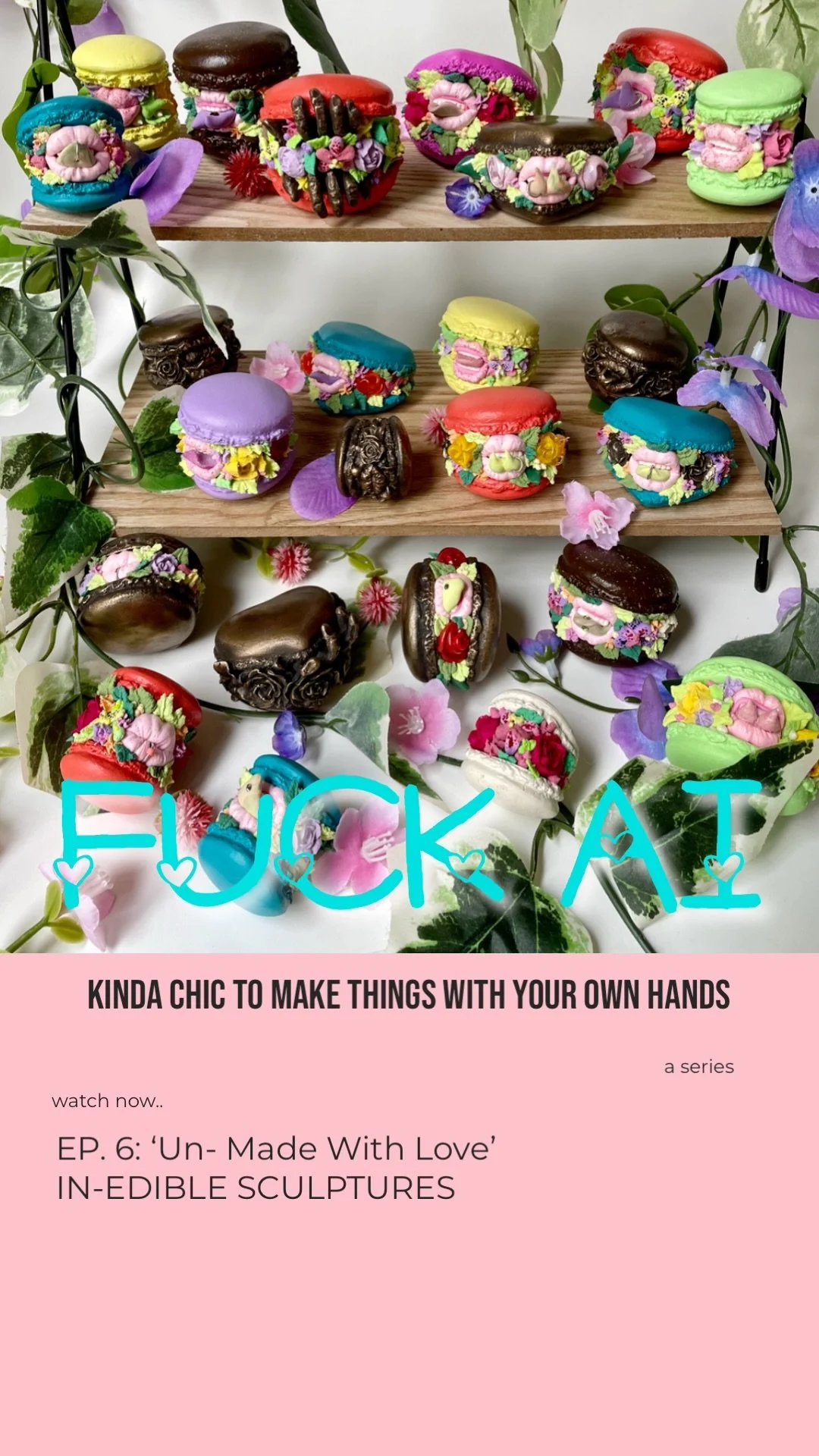
I make Swiss macarons that can be eaten, and macarons translated into bronze and glass. Their shared form allows me to move between appetite and denial, softness and hardness, disappearance and endurance.
My bronze ‘Untouchables’ offer a kind of permanence that an edible macaron cannot. The inedible ‘Taunting’ bouquet macarons play with the desire to reach for, taste, or possess something that seems to invite consumption while withholding it. ‘The Escape’, a large bronze macaron, shifts this intimate confection into another sculptural register.
I am interested in the emotional movement between these encounters. An edible object asks me to accept loss through participation. An inedible version asks what I think I gain by preserving the shape while removing the possibility of eating it.
Neither is simply more valuable than the other.
A bronze macaron can remain, but it cannot offer the same experience as a mouthful shared in a particular room, with particular people, at a moment that will not return.
↑ ‘The Crumbs’ Hand dyed, hand and machine embroidered Irish linen & cotton table cloth. Music credit : ‘Attention’ Doja Cat
The edible macaron disappears, but its disappearance is not necessarily a failure of preservation. It may be the condition through which the work becomes most intimate.
I cannot keep the object and have the experience in exactly the same way. I have to choose how to meet it.
A table of pleasure, contradiction, and detail.
In the first iteration of this work, edible offerings include red velvet, strawberry, and vanilla Battenberg cake; petit fours; ginger crunch; peppermint slice; triple-chocolate and chilli brownie; erotic chocolate bonbons; and orchid and bouquet macarons.
I also create edible flowers through different techniques and ingredients, including chocolate, toffee, homemade marzipan, and rice. These sit within an arrangement that allows the edible, ornamental, natural, and synthetic to overlap without settling into a neat hierarchy.
Every motif, material, colour, flavour, recipe, sound, and detail is chosen with intention.
I am not interested in abundance as an empty visual effect. I want the table’s lushness to hold complexity. Its sweetness can attract people while the work beneath it asks difficult questions about labour, desire, bodily autonomy, and the expectation that care should always be beautiful.
I also want to explore satisfaction as something physical, mental, and spiritual. What does it mean to feel nourished beyond the body—to find stimulation, connection, or a sense of fulfilment? I am interested in where these forms of satisfaction meet, where they pull apart, and whether an experience can satisfy one part of us while leaving another wanting.
The erotic bonbons and edible casts taken from my own body make that relationship more explicit. I place the body within the language of hospitality and consumption, then ask what it means to offer oneself.
What am I giving freely? What might someone assume they are entitled to? Where does an invitation end?
I use playfulness because it can make a difficult conversation approachable, but I do not use it to make the difficulty disappear.
The table can be seductive, humorous, formal, uncomfortable, generous, and withholding at the same time. I recognise those contradictions as part of being human.
↑ Press PLAAY…
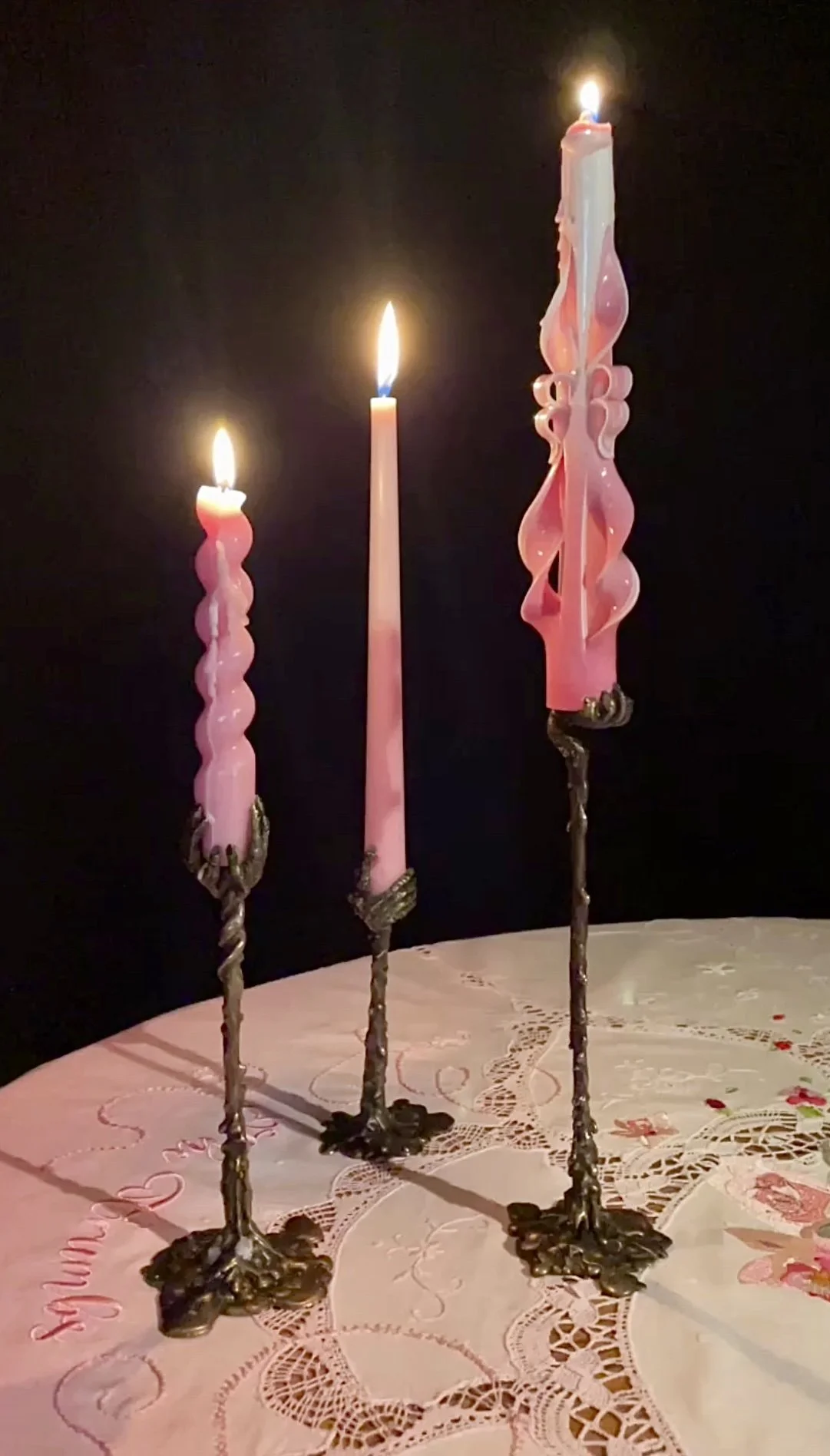
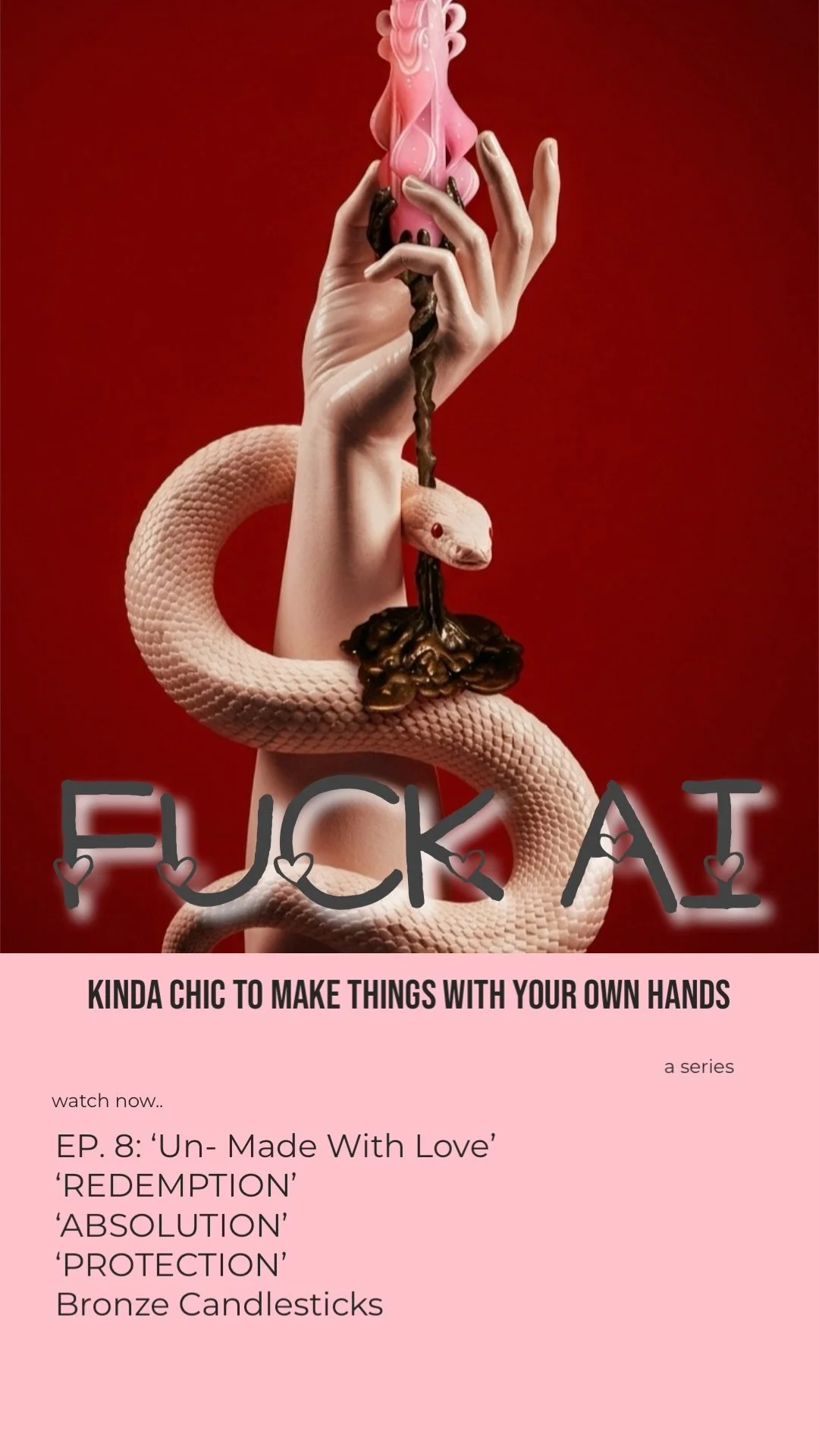
‘The Crumbs’ hand dyed, hand + machine embroidered table cloth. ‘Protection’, ‘Redemption’ & ‘Absolution’ bronze candlesticks.
Music: ‘Under The Table’ - Fiona Apple

↑ … them be videos … Music: ‘I Don’t Like My Mind’ - Mitski
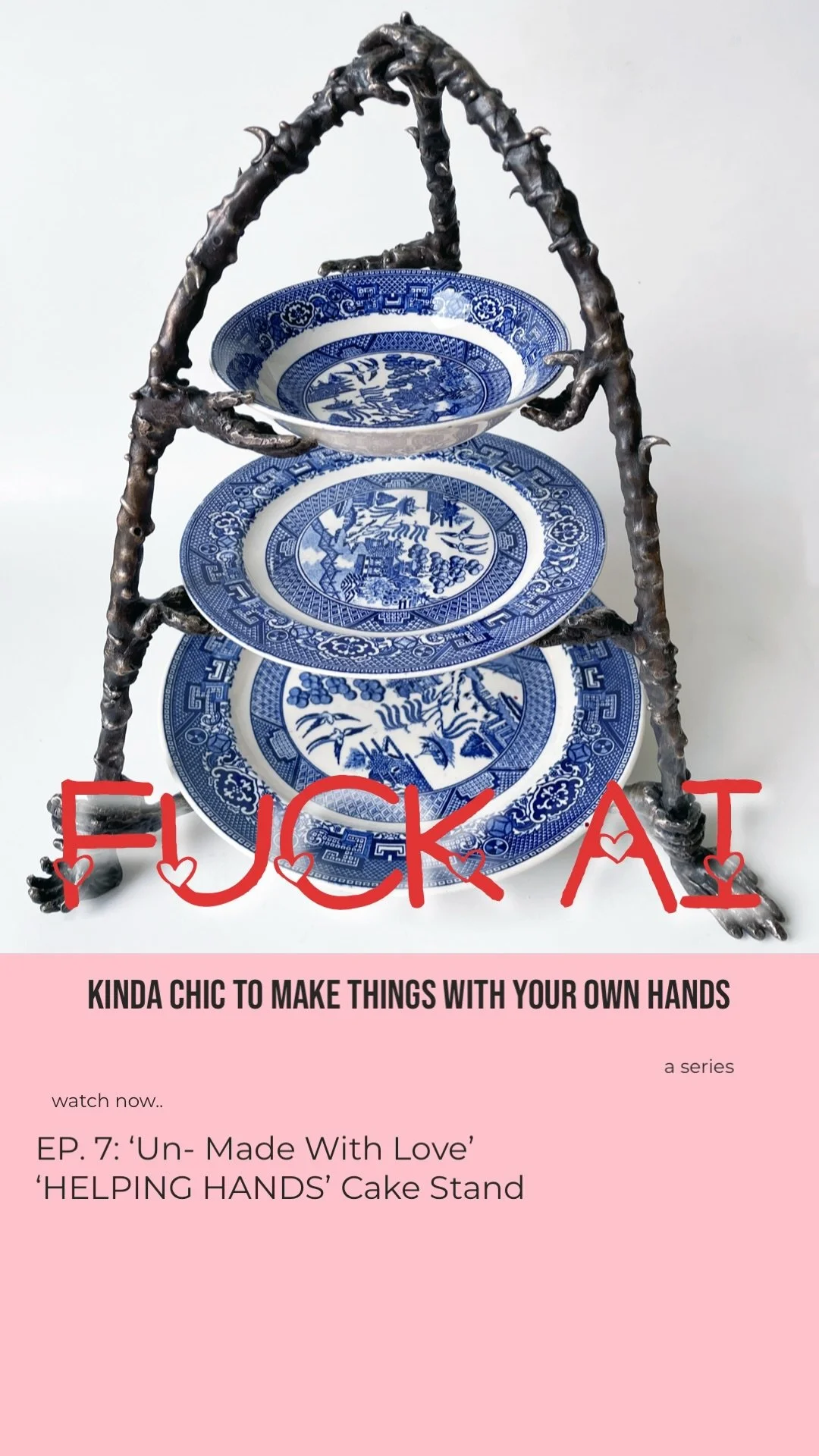
‘Helping Hands’ bronze and Homer Laughlin China cake stand.
Edible art: Red velvet, strawberry & vanilla Battenberg cake, erotic bonbons, triple chocolate & chili brownie, peppermint slice, ginger crunch, petit fours, bouquet & orchid macarons.

↑ .. ahuh - hit it!..
Large bronze macaron, ‘The Escape’ & non-edible ‘Taunting’ bouquet macaron
Music: ‘L’stranger’ - Christine & The Queens
↑ ‘Imperfection’ featuring the red velvet and French vanilla Battenberg cake
Red velvet, vanilla sponge & strawberry jam Battenberg cake atop ‘Imperfection’ a broken Libery Blue china plate reformed by kintusgi with molten bronze.
Kintsugi is the perfect technique to encourage conversation about beauty in the incomplete, wholeness within what is fractured and flawed, and differences creating unity,
Fracture, repair, and Imperfection
I am drawn to repair that does not pretend the break never happened.
Kintsugi, traditionally associated with repairing broken pottery using lacquer and precious-metal powders, offers a way of recognising fracture as part of an object’s history rather than something that must be concealed. I connect with that refusal to make wholeness dependent on looking.
In my own work, I extend that conversation through broken china and (I can’t find anyone else playing around with this) molten bronze. Imperfection brings fractured plates into a new relationship through a bronze-based reinterpretation of repair. On my artwork page, I show the red velvet and French vanilla Battenberg cake, ‘Perfectly Flawed’, sitting above this reworked china and ‘The Crumbs’ tablecloth.
I think about what it means for something delicate to be held through an encounter with something forceful.
The repair does not return the plate to its former state. It creates another state—one that includes what happened to it.
That is important to me because I do not experience recovery as a return to an untouched original self. I cannot unknow what I have lived through. I do not need to.
I want to make room for wholeness that contains fracture, for beauty that includes interruption, and for differences that create unity without becoming identical.
The repaired plate, the embroidered stain, and the transformed relationship with sugar are not interchangeable metaphors, but they speak to one another.
In each, I refuse the idea that the only acceptable future is one in which evidence of difficulty has been removed.
My body, the kitchen, the foundry
I work with the kitchen and dining room as spaces loaded with gendered expectation.
I have felt the weight of the associations gathered around them: maternal provision, abundance, sweetness, femininity, the nourisher, the provider, the goddess. I am interested in both the beauty of those roles and the cost of being confined to them.
I do not want to reject care simply because it has been gendered. I want to reclaim my agency within it.
My practice moves beyond the domestic kitchen into the industrial kitchen, the bronze foundry, and the glass furnace. I place delicate confectionery beside processes involving heat, weight, physical endurance, and technical precision.
The body that makes these objects is not an invisible resource.
My hands, stamina, concentration, and limits are present in the finished work, even when its polished appearance conceals them. When I include edible forms cast from my own body, the relationship between making, offering, and being consumed becomes deliberately literal.
I ask how far a body can be pushed in the service of beauty, production, pleasure, or another person’s expectations.
At the same time, I use the manners and formality of the dining room to hold those questions. Silver service, lace, cakes, flowers, and carefully arranged plates can create an atmosphere of composure while the work carries psychological and psychosexual tension underneath.
I recognise that split. I know what it is to appear composed while an interior life is anything but orderly.
Here, I allow that interior life to emerge—not as an accidental failure of presentation, but as part of the presentation itself.
Reclaiming the forms I am expected to inhabit
I recognise a conversation between my work and the legacies of feminist art, including the challenges to gendered labour, sexism, and representation that came into focus through the 1960s and 1970s.
But my interest is not only in identifying the roles available to women. I want to explore how I can inhabit, alter, and reclaim forms that have been fetishised or dismissed: cakes, lace, the female body, domestic embellishment, and silver service.
I do not believe that something becomes superficial simply because it is beautiful, decorative, pleasurable, or associated with femininity.
Nor do I believe that empowerment requires me to abandon tenderness, hospitality, sensuality, or the desire to nourish.
What matters is agency: whether I am choosing the gesture, whether its labour is recognised, and whether I can remain a person within the act of giving.
I acknowledge Judy Chicago within this lineage, although I encountered her work after bringing my own vision to life. Marina Abramović’s work affected me deeply during Covid, particularly in relation to presence and what an encounter between people can hold.
I am interested in being there—not merely having made something that stands in for me.
I also see a point of conversation with the idea of dining as an immersive, multi-sensory artistic event in The Futurist Cookbook of 1932. I can engage with that formal proposition without endorsing the sexist and nationalist ideology surrounding Marinetti’s project. For me, the useful question is how food, atmosphere, sound, company, and participation can alter the experience of a meal.
I do not simply serve an object and ask someone to judge it. I create conditions in which the encounter itself can become the work.
Risk, precision, and learning to trust myself
Flying, motorcycling, and other physically demanding activities have played an important part in my life and in rebuilding my self-trust.
I do not experience them simply as escapes or displays of fearlessness. I experience them as practices that demand presence, responsibility, and considered decisions.
My mind has often been capable of elaborate anticipation. In the wrong context, that ability could become an exhausting loop of hypothetical dangers and self-doubt. In an activity requiring immediate attention, I could begin to give that same capacity a clearer task.
I had to notice what was happening, assess my position, respond, and take responsibility.
I find related questions in the studio and kitchen. Speed, gravity, humidity, heat, delicate materials, and the requirements of lost-wax casting each demand a relationship between preparation and responsiveness.
I can be meticulous without being omnipotent.
That distinction has been important in learning to trust myself. I do not need a guarantee that nothing will go wrong before I am allowed to act. I need enough understanding to make a considered decision, and enough humility to recognise when conditions require me to change it.
I bring that understanding into ‘𝓤𝓷-𝓜𝓪𝓭𝓮 𝓦𝓲𝓽𝓱 𝓛𝓸𝓿𝓮’. I prepare intensely, but I cannot predetermine what everyone will feel, remember, or contribute. I can set the table; I cannot control the full life of the encounter, nor would I want to.
I have to let other people enter it.

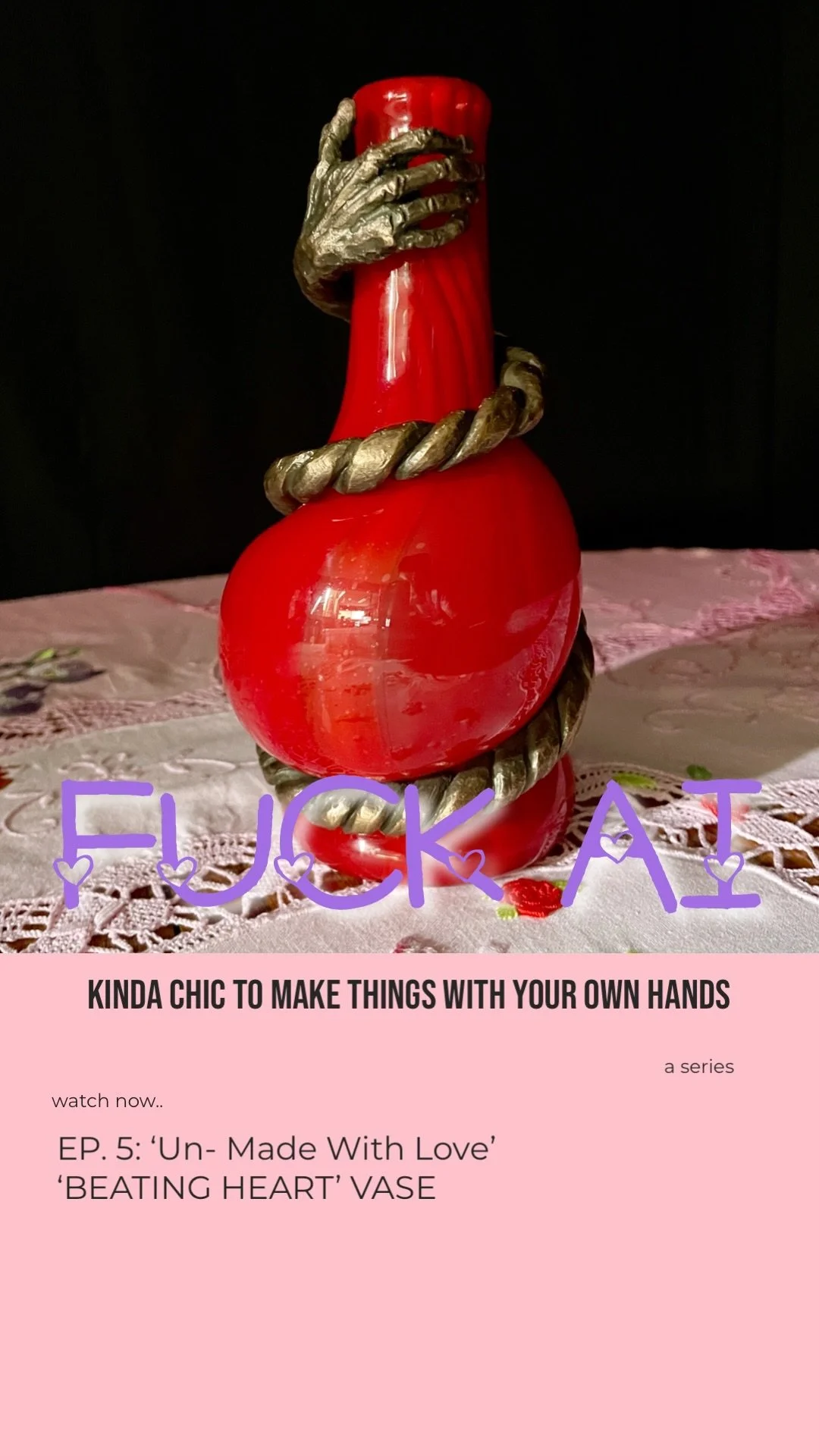
▶ 'Beating Heart' vase - 2024, glass by Joseph Pecoraro, Music credit - 'Sweet' - CSS
‘Beating Heart’ and the people who help me make
At the table, ‘Beating Heart’ brings blown glass into a relationship with a bronze coil, creating a sculptural form that I associate with a beating heart. Its presence connects the arrangement of flowers and vessels to the body and to the emotional life circulating through the work.
My bronze candlesticks—‘Protection’, ‘Redemption’, and ‘Absolution’—introduce another vocabulary into the setting. I place these words within the familiar ritual of a candlelit table, where their meanings (and religious connotations) can sit beside pleasure, hospitality, vulnerability, and the wish to be held safely.
Although this work is intimately connected to me, I do not make it in isolation.
My vision has been brought to life through collaboration with extraordinary makers: Joseph Pecoraro of Long Island Glass, who made the vase glass; Emily Doerflein, whose glass roses and leaves contribute to the bronze macarons; Mary of Zee Candles, Michael and Kristen of Wellsculpt Foundry, who worked with me on the bronze casting; and Mark of the family-owned St James Embroidery, who contributed machine embroidery to ‘The Crumbs’ tablecloth.
I want their hands and knowledge to remain visible in the story.
It would contradict the work’s concern with care and human value to speak as though every technical achievement emerged from me alone. I bring the vision, but collaboration allows it to become something I could not realise in the same way by myself.
I value the conversations, problem-solving, expertise, and trust exchanged through that process.
The relationships involved in making the table are part of the table’s meaning.
What I cannot package and sell
I have found Un-Made With Love confronting—and, at times, intimidating—to traditional gallery systems.
I am not primarily offering an object that can be neatly packaged, carried out under someone’s arm, and possessed independently of the circumstances in which it was encountered.
Although the installation contains objects that can endure, the work as a whole is not linear or conventionally marketable. Its essential experience cannot be separated cleanly from my time, the participants’ presence, and the atmosphere of a particular gathering.
A cake can be eaten. A macaron can disappear in a mouthful. A candle burns down. A conversation moves somewhere I did not expect.
The work does not remain materially intact simply because the encounter has been successful.
I deliberately push against market-driven definitions of artistic value. I ask what happens when words, gestures, hospitality, and presence enter an accredited art space and refuse to behave as secondary elements.
Some components, including the bronze works, could accrue monetary worth over time. I do not deny their material or sculptural significance. But I propose that their value is intrinsically tied to the elements that cannot endure forever.
The permanent objects do not explain the work by themselves.
They belong to a larger relationship with what has been eaten, said, felt, and lost.
I offer an experience built through the combined senses and the energy of the room. Documentation can preserve an image or a sequence of events, but it cannot reproduce the precise experience of being there.
That limitation is not an embarrassment I need to solve. It is part of what I am making.

What remains after I am gone
After I am gone, the most essential elements of this work—my time, interaction, and care—will no longer be available in the same way.
What remains will be traces: bronze and glass macarons, melted candle wax, embroidered marks, photographs, film, and the memories carried by people who sat with me.
I think of these as relics of what once was.
They may become more poignant because the original encounter cannot be recovered. They point towards something rather than containing it completely.
I think of restaurants that no longer exist, of El Bulli, and of Dalí’s extravagant banquets when considering experiences that live beyond their immediate occasion without becoming objects for a wall or vitrine. In my own work, that relationship between an event and its afterlife matters more than the possibility of recreating it exactly.
Each iteration of my table is deliberately different. Flavours, emotion, company, circumstance, and my own changing life shape what happens and what I present.
I resist mass reproduction and sameness because I do not want to promise a return to something that, by its nature, cannot return.
There is a quiet melancholy in that.
I can remember one of life’s most luminous moments, but I cannot step back inside it with the same people, the same body, the same understanding, and the same future still ahead of me.
I do not want to resolve that sadness by pretending permanence is possible. I want to make something beautiful from paying attention while the moment is here.
The value of the human hand
This work holds a mirror to the systems through which art is valued, but it also asks a broader question about how I want to live.
Have I begun to care more about the thing than the person who made it?
Do I recognise the effort behind an offering, or only evaluate its appearance and usefulness?
When I value speed, consistency, and reproducibility, what kinds of human difference do I risk treating as inconvenience?
My questions about machines and AI come from that concern. I am not trying to make a prediction about every future use of technology. I am asking what I want to protect when efficiency becomes a dominant measure of worth.
For me, the human hand matters not because it guarantees perfection, but because it carries the evidence of attention, limitation, judgement, time and accumulative skills.
My work contains those limitations. A stitch records a decision. A handmade sweet reflects conditions that cannot be made entirely identical. A conversation depends on someone listening rather than simply producing a response.
By elevating perishable materials, I ask whether care, energy, and shared experience can be recognised as valuable without needing to justify themselves through permanence.
I am interested in what I cannot retain as property but can carry as a changed feeling.
A memory. A moment of ease. The knowledge that someone made space for me.
Tall poppies and the cost of becoming visible
Another major theme within 𝓤𝓷-𝓜𝓪𝓭𝓮 𝓦𝓲𝓽𝓱 𝓛𝓸𝓿𝓮 is Tall Poppy Syndrome, which I experienced painfully in New Zealand, my home country.
I use that phrase to describe the tendency to criticise, resent, or undermine people who stand out through achievement, ambition, difference, or an unwillingness to stay within an expected shape or trajectory.
In my experience, the pressure was not always delivered openly. It could arrive as snide humour, a compliment with a sting inside it, or an accusation of taking myself too seriously. A person can be praised and diminished in the same sentence.
I love Aotearoa (New Zealand) deeply. I do not want my hurt to become a claim that every New Zealander behaves this way, or that the place that shaped me can be reduced to one cultural problem. But I also do not want affection for home to require silence about something that damaged my self-worth, and the self-worth of many others.
Being repeatedly criticised, undermined, backstabbed, or ostracised for standing out is not a small thing. It causes psychological injury. It damages your sense of safety in communities, workplaces, and families, until trust feels dangerous and being visible feels like a threat. We are wired to belong, so being cut down by your own people can bring on a raw panic and fear of abandonment that can feel and manifest in very physical ways.
I became tired of hearing “overachiever” as though it described a character flaw. I became worn out by feeling that enthusiasm had to be softened, achievement apologised for, and difference made less visible to keep other people comfortable.
Over time, those messages entered my own thinking. When this pressure goes on for years, it can produce symptoms resembling chronic trauma: hypervigilance, constant anxiety, dread of what comes next, emotional exhaustion, and a deep imposter syndrome. I questioned whether wanting something was arrogant, whether speaking confidently was unkind, and whether being good at several things made my intentions suspect. Like many people, I learned to hide my talents, downplay my wins, and sometimes sabotage myself to avoid the punishment that seemed to follow success. It was a survival strategy, much like freezing or fawning.
That matters to this work because I cannot separate the recovery of my appetite from the recovery of my right to take up space.
There were three occasions when the darkness of my eating dis’order’, fuelled by negative voices whipped into a chorus by Tall Poppy mentality, became so overwhelming that I tried to end my life. I do not share that as a dramatic embellishment to the work. I share it because it is part of the truth the work came from. I felt imprisoned by compulsions I could not imagine escaping, and punished by others, and then by myself, for daring to dream of better solutions.
I have had to learn that I can offer something without diminishing it in advance. I can acknowledge skill without pretending it arrived effortlessly. I can care about others without making myself smaller.
The table becomes a place to examine the difference between genuine equality and enforced sameness.
I do not want to elevate myself by cutting someone else down. I want room for more than one person to flourish.
I want generosity that expands possibility rather than a social contract in which belonging depends on staying below an invisible line.
Sweetness without obedience
I am conscious that the visual language of my work can be mistaken for compliance.
A beautiful table. A woman serving food. Flowers, lace, elaborate sweets, candles, and careful manners.
I know how readily those forms can be read as decorative, accommodating, or harmless.
But I do not see sweetness as the absence of force.
I can be hospitable without being submissive. I can make something pleasurable without agreeing to become an endlessly available source of pleasure. I can care for people while asking them to think about what care costs.
I am interested in holding those positions together rather than choosing a simpler identity.
My table is an invitation, not an agreement to disappear behind what I provide.
The work asks me to remain present within my own offering—to speak, to receive, to set limits, and to allow my complexity to be part of the encounter.
In that sense, ‘𝓤𝓷-𝓜𝓪𝓭𝓮 𝓦𝓲𝓽𝓱 𝓛𝓸𝓿𝓮’ is not only about nourishing others. It is also about learning how not to abandon myself while doing so.
Gourmet edible macarons made with only the finest local and imported artisanal & organic ingredients.
The price of this box of delights is directly creating dialogue around the value of Time.


Easter, and the person I once was
Easter can still bring me into contact with the memory of how difficult this time of year once felt, and sharp empathy for others going through what I used to.
I understand how something presented as joyful can become overwhelming when food carries fear, compulsion, or shame. I remember watching others appear relaxed around treats and wondering whether I would ever know that ease. My friends would share dreams of luxury homes and travel; I was too shy and ashamed to admit, I dreamed of being able to eat pancakes for breakfast, to sit in the sun with children of my own and enjoy an ice cream. To be able to absorb the pleasure of eating my own birthday cake.
When I speak about recovery, I am speaking to the person I once was as much as to anyone encountering my work now.
I want little me to know that what she believed impossible did become possible.
I want her to know that she did not need more disgust directed at herself. She needed care, understanding, support, and the possibility of a life not organised entirely around the next battle with food.
I remember how tired my mind could become later in the day, how thoughts gathered force when I felt depleted, and how easily a difficult afternoon could seem like proof that nothing would ever change.
Sometimes my first act of care was small: lying down, running a bath, putting on music, or allowing myself a quiet moment without demanding an immediate transformation.
I do not present those moments as treatment or as a substitute for support. I remember them as ways of interrupting my own harshness long enough to recognise that I was struggling. And that struggling is ok- it’s valid, it doesn’t have to be pushed aside or moved over.
I have come to understand that I was a person living with an illness, not an illness pretending to be a person.
I could take my suffering seriously without making it the whole of my identity.
The work carries that understanding. Beneath its formal setting and elaborate surfaces is a desire to make room for the self who feels ashamed to arrive.

↑….you know you waant toooo…. :P
‘Beating Heart’ vase with edible flowers. Music: 'Ice Cream' - New Young Pony Club
Imperfection as a place of connection
I find connection in the qualities I once tried hardest to hide.
My limitations, inadequacies, contradictions, and frailties have made me more able to recognise the vulnerability in others. They have helped me listen beneath behaviour rather than assume that what is visible is the whole story.
I think often of the inner child who still needs reassurance that she is enough as she is.
I do not want to make that child earn her place at the table through achievement.
Nor do I want to romanticise suffering as a requirement for making meaningful art- I had become conditioned to a cycle of pain and create. I would not choose every wound again simply because I have found ways to work with it.
What I can choose now is how I attend to its aftermath.
I can embroider rather than erase. I can repair without disguising. I can present authentically flaws included. I can share food without turning it into punishment. I can make something beautiful without pretending that beauty has solved everything.
I can let my horrible sit beside my beautiful, and discover that neither needs to expel the other.
For me, imperfection is not a decorative theme placed over an otherwise immaculate process. It is the condition through which the work remains honest.
Although this work emerges from difficult experiences, I do not want my suffering to become its only point of entry.
I am also funny, curious, ambitious, sensual, restless, technically absorbed, and capable of enormous delight. I love the absurdity of an elaborate confection. I love a detail that someone notices only after looking for a long time. I love the moment when seriousness loosens and a room begins to laugh.
The work can carry grief without asking everyone to grieve. It can acknowledge shame without making shame the dominant atmosphere. Its beauty is not a disguise for the difficult material; it is also an expression of what I have fought to recover.
I wanted more than survival. I wanted a life in which pleasure belongs to me.
Receiving what I have learned to give
One of the questions this work continues to ask of me is whether I can receive the care I know how to offer.
Making gives me something to do with my hands. Hosting gives me a role. There is reassurance in being useful, in anticipating what is needed, in knowing where the plates belong and when the next course should arrive.
Receiving asks something different of me.
I have to allow another person’s attention to reach me without immediately repaying it, qualifying it, or redirecting the conversation towards what I can provide for them. I have to consider the possibility that my presence is enough, even when I am not producing something.
I do not find that simple.
There is a particular vulnerability in sitting at the table rather than remaining safely occupied behind it. My work asks me to practise that vulnerability. I cannot speak honestly about the value of human presence while treating my own presence as valuable only when it is accompanied by exceptional output.
I am learning to notice when generosity comes from pleasure and when it becomes an attempt to secure belonging.
Both can look beautiful from the outside. Inside, they feel different.
I want to keep the pleasure of giving without making it the price of being loved.
(left) Completely edible flowers using a variety of techniques, ingredients, chocolate, toffee, homemade marzipan, rice and more!
(right) To eat or be eaten…? dehydrated kiwifruit from a most likely dehydrated kiwi
Small and large solid bronze ‘Untouchables’ macarons
A place for my daughters, and for ‘selves still becoming
As a mother of two, I think about what I pass on through the ordinary atmosphere of daily life: the words I use about my body, the way I respond to mistakes, the permission I give myself to rest, and the relationship between nourishment and affection.
I cannot rewrite every inherited story. I can become more attentive to the ones I repeat.
I want to make room for appetite without moral judgement, achievement without apology, and imperfection without humiliation. I want care to include the person doing the caring.
I also want to leave space for difference. The people I love do not need to become versions of me in order for our relationship to be meaningful. I do not want the table to become another place where belonging depends on performing the right identity.
When I speak about generational patterns, I am not interested only in identifying what hurt. I am interested in the small choices through which I might stop handing that hurt forward unchanged. These progress like ripples from internal, to family relationships to friends/ lovers / acquaintances and on to, community (linking to Tall Poppy in New Zealand) and New York (fear of aging, youth culture, and the obsession with preened perfection).
Sometimes that choice is a conversation. Sometimes it is an apology. Sometimes it is allowing a meal to remain a meal rather than turning it into a measure of discipline, virtue, or worth.
Those gestures may be less spectacular than the installation, but they belong to the same questions.

What I hope you carry away
I cannot decide what another person will take from my table. Someone may remember a flavour before anything else. Someone may recognise the exhaustion of being the person who always provides. Someone may feel unsettled by the proximity of an edible object to an almost identical object that cannot be eaten.
Someone else may simply enjoy themselves.
I make room for that, too. I do not want pleasure to become another examination that a participant must pass by arriving at the correct interpretation. I have spent enough of my life making eating difficult. I do not wish to recreate that difficulty under the authority of art.
The deeper meanings are there, but I do not demand confession in exchange for hospitality. No one needs to disclose a painful history to deserve a place at my table. I can offer an invitation without claiming access to everything a person carries.
That boundary matters to me. Sharing can create intimacy, but so can the knowledge that I am allowed to remain quiet. I want the encounter to hold both possibilities.
If someone leaves with a new question about value, labour, appetite, or the way they speak to themselves, I welcome that. If they leave remembering that, for a little while, they felt comfortable in their own company and in the company of others, I value that just as deeply.
An undoing while making
The title ‘𝓤𝓷-𝓜𝓪𝓭𝓮 𝓦𝓲𝓽𝓱 𝓛𝓸𝓿𝓮’ holds several movements at once.
I make something that may be undone through eating.
I revisit the beliefs through which I once understood love, provision, value, and my own body.
I allow an artwork to change through another person’s participation rather than protect it from every alteration.
I make objects that endure and experiences that do not, then ask how each changes the meaning of the other.
I also unmake the idea that healing must leave no trace of what came before.
I do not arrive at this table as a finished person presenting a finished answer. I arrive as someone still becoming, using material, ritual, conversation, and care to think through what it means to live with greater honesty.
The work was shortlisted in the final round for Spring Break New York in 2024, but its life is not contained by that recognition. I understand it as an ongoing practice whose questions continue beyond a particular exhibition.
I am still asking how to give without vanishing, how to receive without shame, how to trust pleasure, and how to let a moment end without deciding it was therefore worth less.


↑ ‘Taunting’ Inedible Macarons - bronze, glass, mixed media, 2024
Love is my secret ingredient
I can say, with my hand on my heart—and yes, I know this is a big call—that you have never tasted baking quite like mine.
Love is my secret ingredient.
I do not mean that as a substitute for technique. I mean the attention inside it: the decisions, the testing, the memory, the recipes passed on from other people who have loved and cherished them; the care taken over a flavour, the willingness to spend a week making something that may last only a mouthful.
I mean the desire to offer an experience that is felt as well as tasted.
For me, love is not separate from the labour. It is present in how I choose to perform it, whom I make room for, and whether I can include myself within the care I offer.
I want the person at my table to encounter more than an impressive object.
I want there to be space for delight and discomfort, appetite and reflection, grief and humour, the formal and the playful, the enduring and the ephemeral.
I want to honour the possibility that something can disappear and still change us.
So I invite you to pause with me.
To sit. To taste what is offered for tasting. To notice what cannot be consumed. To talk, to listen, to remember.
To let the crumbs fall.
And to allow what follows to become part of the work.
I cannot hold the encounter still, and I cannot turn every meaningful moment into something permanent. What I can do is attend to it, while it happens and afterwards, with as much honesty as I can bring.
That attention is where I locate the love in this work.
Not in a promise that nothing will break, that no one will leave, or that everything offered will be understood.
I locate it in the willingness to make, to share, to listen, and to remain open to being changed.
I lay the table knowing that it will not stay as I arranged it.
I make the food knowing that it will disappear.
I begin conversations knowing that they may take us both to somewhere we could not have reached alone.
And when the gathering is over, I return to the cloth.
I thread the needle.
I begin again.


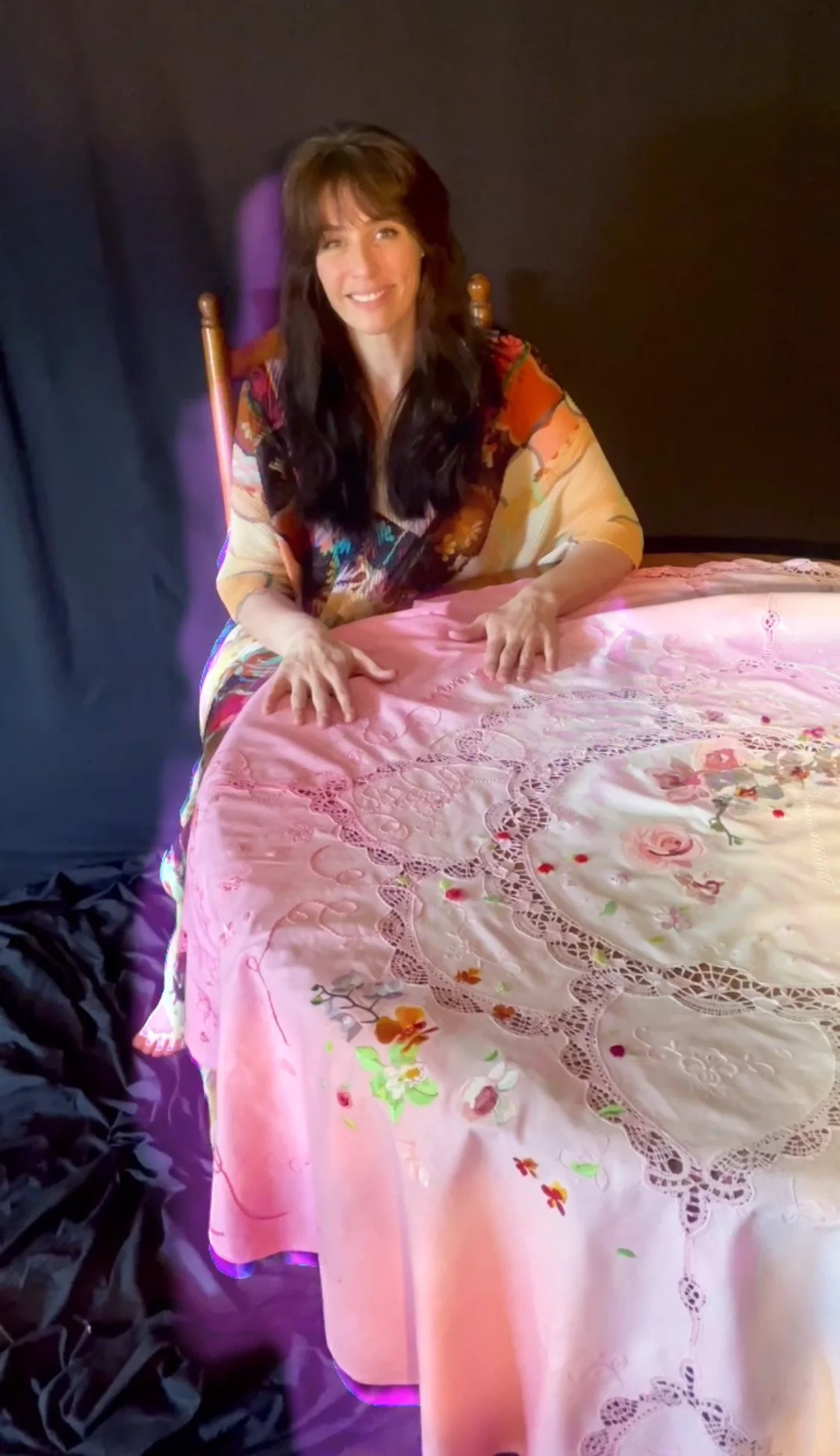
Embroidery over the marks made during the first sitting.
°❀⋆.ೃ࿔*:・°❀⋆.ೃ࿔*:・

Vase glass by Joseph Pecoraro of Long Island Glass, Glass roses & leaves by Emily Doerflein, Carved candles by Mary of Zee Candles, Bronze cast with the fabulous duo Michael & Kristen of Wellsculpt Foundry and machine embroidery by Mark of the family owned and operated St James Embroidery. Collaborating with these phenomenal artists has breathed life into my vision- I couldn’t do it without you all- thank you so much
°❀⋆.ೃ࿔*:・°❀⋆.ೃ࿔*:・
Look out for these reels on my Instagram. They unpackage each individual art piece making up ‘𝓤𝓷-𝓜𝓪𝓭𝓮 𝓦𝓲𝓽𝓱 𝓛𝓸𝓿𝓮’ and there are also artist perspectives.
°❀⋆.ೃ࿔*:・°❀⋆.ೃ࿔*:・